

New PFAS Monitoring Requirements in NSW: What Landfills and Sewage Treatment Plants Need to Know
New NSW PFAS monitoring requirements are now in effect for licensed landfills and sewage treatment plants.
From 1 October 2026, licensed landfills and sewage treatment plants are subject to new PFAS monitoring and reporting requirements under the NSW EPA’s Landfill and Sewage Treatment Plant PFAS Monitoring Chemical Control Order.
The new requirements are designed to create more consistent PFAS data across NSW, improve understanding of PFAS pathways and help inform future regulatory decisions.
What do the NSW PFAS monitoring requirements mean for operators?
The new Chemical Control Order applies to licensed:
- Landfills
- Sewage Treatment Plants
Relevant facilities are required to undertake PFAS monitoring at specified locations, use approved sampling and analytical methods and report results to the NSW EPA.
Monitoring is required on a quarterly basis.
For landfills, monitoring may include landfill leachate as well as associated groundwater or surface water. For sewage treatment plants, the requirements apply to treated effluent discharged to the environment.
Which PFAS compounds are being monitored?
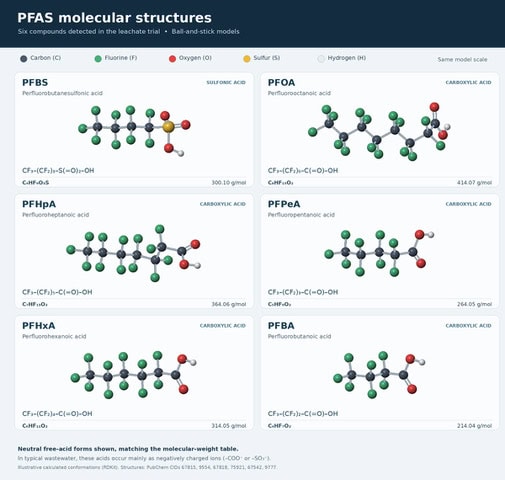
The Chemical Control Order identifies four PFAS compounds for monitoring:
- PFOA
- PFOS
- PFHxS
- PFBS
The monitoring requirements align with Australia’s broader national PFAS management framework, including the PFAS National Environmental Management Plan.
Monitoring is only the first step
For many operators, the immediate focus will be understanding the PFAS concentrations present in their wastewater, leachate or effluent.
But where PFAS is identified, the next question becomes more practical:
What can actually be done with the water?
PFAS treatment is rarely just a matter of selecting a single chemical or piece of equipment.
A workable treatment pathway may need to consider:
- PFAS concentration and composition
- wastewater chemistry
- flow variation
- treatment dose and contact time
- solids separation
- residual waste management
- downstream treatment requirements
- operating cost
- the final destination of the treated water
This is why treatability testing is important before moving into full-scale equipment selection or plant design.
Qtech’s approach to PFAS treatment
Qtech Australia has been developing treatment pathways for challenging industrial wastewater and leachate using P-FiQX, our adsorption treatment product designed to capture persistent contaminants such as PFAS within an engineered treatment process.
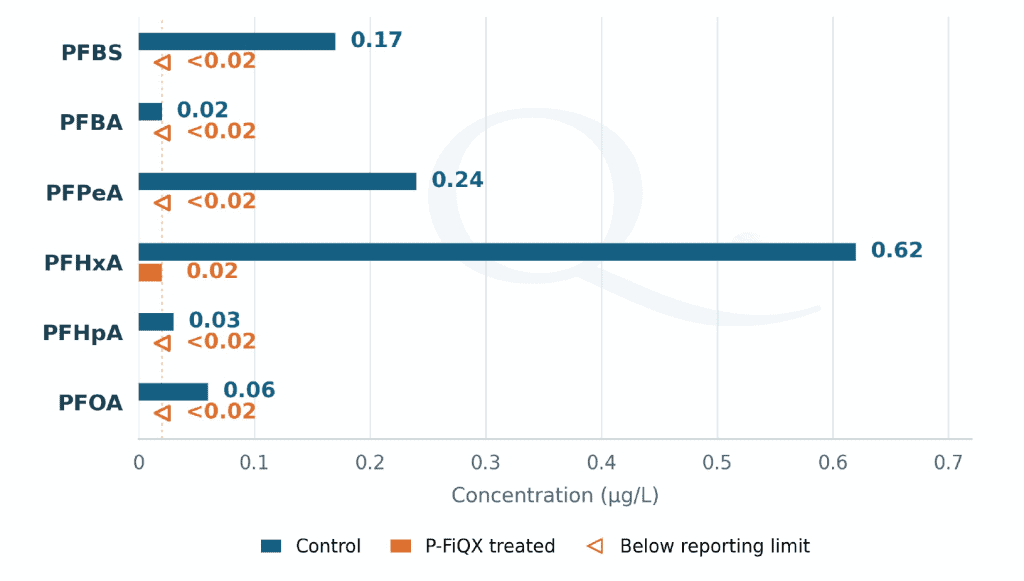
In preliminary testing on biomass composting leachate, PFHxA was reduced from 0.62 µg/L to 0.02 µg/L, representing a 96.8% reduction under the tested conditions.
Several other individual PFAS compounds in the treated sample were also reported below the laboratory reporting limit of 0.02 µg/L.
These results are preliminary and specific to the tested water and treatment conditions.
Treatability testing and site trials are still required to establish repeatability, dosage, treatment capacity, solids recovery and downstream requirements for each site. Captured PFAS also remains within the residual waste and must be appropriately managed.
From PFAS monitoring to treatment assessment
The NSW PFAS monitoring requirements will provide operators with more consistent information about PFAS concentrations and pathways. Where results indicate a need for further investigation, the next step may be to assess how the wastewater responds to treatment.
They do, however, create a much clearer picture of PFAS concentrations and pathways across the state.
For operators who identify PFAS levels requiring further investigation, Qtech can assess the wastewater, undertake bench testing and help determine whether a practical treatment pathway exists.
Our approach can include:
- review of PFAS and water analysis
- bench-scale treatability testing
- assessment of P-FiQX dosage and contact time
- solids separation trials
- pilot testing where appropriate
- engineering of treatment systems
- integration with existing wastewater infrastructure
Qtech’s PFAS treatment process is designed around the characteristics of the actual wastewater rather than a standard off-the-shelf system.
Need to assess PFAS in your wastewater?
If you already have PFAS monitoring results, the next step is to understand how your wastewater responds to treatment.
Explore Qtech’s PFAS Treatment for Industrial Wastewater